Mostrando entradas con la etiqueta Canciones sobre la WW II. Mostrar todas las entradas

martes, 23 de octubre de 2012

Canciones sobre la 2ª Guerra Mundial (9)

Vamos a animar un poco el cotarro con un algo de música y de paso resucitamos de su ostracismo esta sección del blog. Hoy visitan esta sección unos viejos conocidos (es la 3ª vez que aparecen por aquí, si no me equivoco): la mítica banda británica de heavy metal, Iron Maiden.


El tema en cuestión se llama "Tailgunner", incluido en su octavo lp "No Prayer for the Dying" (1990), nos cuenta las vivencias de un artillero de cola de un bombardero pesado aliado durante la Segunda Guerra Mundial, con referencias a las campañas de bombardeos sobre Alemania (Dresde, Colonia, Frankfurt) y al lanzamiento de la primera bomba atómica sobre Hiroshima por el "Enola Gay". Como es tradición, a continuación os transcribo la letra de la canción y un poco más abajo un vídeo de la misma:

"Trace your way back 50 years
To the Glow of Dresden - blood and tears
In the black above by the cruel searchlight
Men will die and men will fight - yeah!
Who shot who and who fired first?
Dripping death to whet the blood thirst
No radar lock on - skin and bone
The bomber boys are going home

Climb into the sky never wonder why - Tailgunner
You're a Tailgunner
Climb into the sky never wonder why - Tailgunner
You're a Tailgunner
Climb into the sky never wonder why - Tailgunner
You're a Tailgunner
Climb into the sky never wonder why - Tailgunner
You're a Tailgunner

Nail that Fokker kill that son,
Gonna blow your guts out with my gun,
The weather forecasts good for war
Cologne and Frankfurt? have some more!
Tail end Charlie in the boiling sky
The Enola Gay was my last try
Now that this Tailgunner's gone
No more Bombers, just one big bomb

Climb into the sky never wonder why - Tailgunner
You're a Tailgunner
Climb into the sky never wonder why - Tailgunner
You're a Tailgunner
Climb into the sky never wonder why - Tailgunner
You're a Tailgunner
Climb into the sky never wonder why - Tailgunner
You're a Tailgunner"

miércoles, 20 de junio de 2012

Canciones sobre la 2ª Guerra Mundial (8)

Retomo esta (algo olvidada) sección y os traigo otra nueva canción cuya temática gira en torno a hechos y/o personajes de la Segunda Guerra Mundial


De nuevo arriban a estos lares los norteamericanos Slayer, banda de thrash metal mítica donde las haya. El tema en cuestión, incluido en su último lp de estudio, "World Painted Blood" (2009), se llama "Unit 731" y nos cuenta los terribles experimentos médicos, biológicos y químicos con humanos realizados por el infame Escuadrón 731 japonés del Dr. Shiro Ishii.

Como ya es tradición, a continuación os dejo la letra del tema, y un poquito más abajo la canción en un vídeo de youtube:

"I am the last of the dying insane
You would scream at the things I've done
Knowing that the dead still see
My blood it runs like mercury

Your last breath, the sword comes down 
She dies first speaking death to me 
Philosophy, the vision, the view within 
duty, science, abstract cruelty

What are your final thoughts? 
Do you want to kill me or die in shame? 
From my point of view 
Justified action, the enemy burns 

The fun of massacre in the brain 
Bioweapons and I are the same 
Look at their face, hatred in their blood 
Pile up the dead, my humanity 

X-rays burn all that you can see
Nobody knows what a body can stand 
Skulls on fire, yet mercy is worse 
You seek only your pleasure in death 

What are your final thoughts?
Do you want to kill me or die in shame?
 From my point of view 
Justified action, the enemy burns 

Bacterial target, eyes exploding 
Melting flesh through your mind 
Become your madness, insanity wins 
Infant's flesh on the walls 
Testing limits, threshold of pain 
Ripping out teeth to observe 
I want blood!!! 

 Knowing now the dead still see 
My blood it runs like mercury 
Knowing now the dead still see 
My blood it runs like mercury 
Knowing now the dead still see 
My blood it runs like mercury 
Knowing now the dead still see 
My blood it runs like mercury! 

Human brain experiment 
on prisoners, open skull 
Vivisection, live dissection 
Repulsing to the core 

What are your final thoughts? 
Do you want to kill me or die in shame? 
From my point of view 
Justified action, the enemy burns!

 Fucking burns!!! 

Pathogens seek horrible end 
Churning factories of death
Crematoriums see your crime
You will see me in Hell!"

jueves, 19 de abril de 2012

Canciones sobre la 2ª Guerra Mundial (7)

Continuamos en esta sección con una nueva andanada musical. Además lo hacemos con caña burra, no recomendada para oídos sensibles (luego no digáis que no os avisé).


Hoy nos visitan unos fulanos llamados Hail of Bullets, una banda holandesa de death metal, cuyas letras giran todas en torno a la temática de la WW II. La canción que hoy os propongo se llama "Nachthexen (Night Witches)", incluida en su primer lp "...Of Frost and War" publicado en el año 2008.

El tema nos habla de las aviadoras soviéticas del 588 Regimiento de Bombardeo Nocturno, conocidas por los alemanes como "Die Nachtexen" - algo así como las "brujas nocturnas"  -, quienes pese a pilotar los vetustos biplanos Polikarpov PO-2, que sólo podían transportar 2 bombas (lo que les obligaba a realizar múltiples misiones en una sola noche), lograron ser bastante efectivas y adquirieron mucho renombre, así como un buen número de condecoraciones. Por cierto, la primera vez que oí hablar de estas intrépidas pilotos fue en un post de mi paisano Mr. Lombreeze publicado en su imprescindible blog "De Gusanos y Lombrices" (y que podéis leer aquí).

Como ya es tradición, a continuación os dejo la letra del tema, y un poquito más abajo la canción en un vídeo de youtube:

"Summer 1941
Instructors start to train 
A night bomber squadron 
The 588th 
Regiment of women 
From pilots to mechanics 
Claim their role in history 
These aviatrixes 

Polikarpov biplanes 
Providing ground support
Temperature plummeting 
To -54 
Climbing the dark cloudened sky 
Engaged in dog-fights 
Up to 18 missions 
In one single night

 High above Rodina
For the umpteenth raid 
Female fighter aces 
Send their bombs away
Through the deafening sirens
Struck by heavy flak 
Although riddled with bullets
All made it safely back 

Shrieking madonnas 
Lead spitting banshees 
Baptize them in fire 
Iron Valkyries
Incoming Nachthexen 
Set the ground ablaze 
Push the throttle up again 
And hear their screams of pain"

jueves, 23 de febrero de 2012

Canciones sobre la 2ª Guerra Mundial (6)

Seguimos con una nueva andanada musical. Tras la calma y la lírica de la anterior entrega, retomamos la caña y los sonidos metaleros con unos viejos conocidos que ya visitaron esta sección (y ya os anticipo que no será la última vez que aparezcan por aquí).

Se trata de los británicos Iron Maiden y del tema "The Longest Day" incluido en su álbum de 2006 "A Matter of Life and Death". Seguro que ya habréis adivinado sobre que va la canción ¿no? En efecto, estáis en lo cierto: habla del Desembarco de Normandía.


Siguiendo la dinámica habitual de esta sección, a continuación os dejo la letra del tema, y un poquito más abajo la canción en un vídeo subtitulado en castellano con un imágenes del film "Salvar al Soldado Ryan" (1998):

"In the gloom, the gathering storm abates
In the ship gimlet, eyes await
The call to arms to hammer at the gates
To blow them wide, throw evil to its fate

All summers long the drills to build the machine
To turn men from flesh and blood to steel
From paper soldiers to bodies on the beach
From summer sands to armageddon's reach

Overload, your master not your god
The enemy coast dawning grey with scud
These wretched souls puking, shaking fear
To take a bullet for those who sent them here

The world's alight, the cliffs erupt in flame
No escape, remorseless sharpnel rains
Drowning men, no chance for a warrior's fate
A chocking death, enter hell's gates

Sliding we go, only fear on our side
To the edge of the wire,
and we rush with the tide
Oh the water is red,
with the blood of the dead
But I'm still alive, pray to God I survive

How long on this longest day
'Til we finally make it through?
How long on this longest day
'Til we finally make it through?

The rising dead, faces bloated, torn
They are relieved, the living wait their turn
Your number's up, the bullets got your name
You still go on, to the hell and back again

Valhalla waits, valkyries rise and fall
The warrior tombs lie open for us all
A ghostly hand reaches through the veil
Blood and sand, we will prevail

Sliding we go, only fear on our side
To the edge of the wire,
and we rush with the tide
Oh the water is red,
with the blood of the dead
But I'm still alive, pray to God I survive

How long on this longest day
'Til we finally make it through?
How long on this longest day
'Til we finally make it through?

How long on this longest day
'Til we finally make it through?
How long on this longest day
'Til we finally make it through?"

martes, 7 de febrero de 2012

Canciones sobre la 2ª Guerra Mundial (5)

Realmente no sé si ésta sección le interesará a alguien, pero como buen melómano que soy, yo sigo a lo mío tratando de unir dos de mis pasiones, la Segunda Guerra Mundial y la música. En este nueva entrega os traigo "La Complainte du Partisan" (o "The Partisan") la mítica canción escrita en el año 1943 por Emmanuel d'Astier de la Vigerie durante su exilio en Londres, poniendo letra a la música compuesta por Anna Marly, y que se convirtió en todo un himno de la Resistencia Francesa. 


Originalmente escrita en francés, fue adaptada al inglés por Hy Zaret y versionada por diferentes artistas como Joan Baez, 16 Horsepower o Red Union, pero sin duda la versión más famosa es la interpretada por el canadiense Leonard Cohen, quien la incluyó en su álbum "Songs from a Room" (1969).

Como es habitual en esta sección, a continuación tenéis la letra de la canción, y seguidamente, un vídeo del tema (que además está subtitulado en castellano):
"When they poured across the border 
I was cautioned to surrender,
this I could not do; 
I took my gun and vanished. 
I have changed my name so often, 
I've lost my wife and children but
I have many friends, and some of them are with me. 

An old woman gave us shelter, 
kept us hidden in the garret, 
then the soldiers came; 
she died without a whisper. 

There were three of us this morning 
I'm the only one this evening but 
I must go on; 
the frontiers are my prison. 

Oh, the wind, the wind is blowing,
through the graves the wind is blowing, 
freedom soon will come; 
then we'll come from the shadows. 

Les Allemands e'taient chez moi, (The Germans were at my home)
ils me dirent, "Signe toi," (They said, "Sign yourself,") 
mais je n'ai pas peur; (But I am not afraid) 
j'ai repris mon arme. (I have retaken my weapon.)

J'ai change' cent fois de nom, (I have changed names a hundred times) 
j'ai perdu femme et enfants (I have lost wife and children) 
mais j'ai tant d'amis; (But I have so many friends) 
j'ai la France entie`re. (I have all of France) 

Un vieil homme dans un grenier (An old man, in an attic) 
pour la nuit nous a cache', (Hid us for the night) 
les Allemands l'ont pris; (The Germans captured him)
il est mort sans surprise. (He died without surprise.) 

Oh, the wind, the wind is blowing, 
through the graves the wind is blowing, 
freedom soon will come; 
then we'll come from the shadows."

martes, 24 de enero de 2012

Canciones sobre la 2ª Guerra Mundial (4)

En la presente entrega de esta sección musical del blog, os hablo hoy de Sabaton, un grupo de power metal sueco, que suele incluir en sus discos abundantes canciones de temática bélica, en especial, sobre la Segunda Guerra Mundial. El tema en cuestión es "Stalingrad", incluido en su segundo álbum "Primo Victoria" (2005), y que, como podéis imaginar, habla sobre la fundamental y decisiva Batalla de Stalingrado, que supuso un estrepitosa derrota alemana, la aniquilación del VI Ejército Alemán al mando del Mariscal Friedich Paulus y el comienzo del fin de la otrora todopoderosa Wehrmacht.


Como es habitual en esta sección, a continuación tenéis la letra de la canción, y seguidamente, un vídeo del tema hecho por un aficionado con imágenes reales de la batalla:

"Fresh from Moscow 
Over Volga came to comrades aid
City in despair 
Almost crushed by the Führers army

Oh it's colder than hell 
Hitlers forces advancing

The sound of mortars 
The music of death 
A grand symphony

See your friends fall 
Hear them pray to the god your country denies 
Every man dies alone 
And when your time comes you will know that it's time 

Stalins fortress on fire 
Is this madness or hell 

The sound of the mortars 
The music of death 
We're playing the devils symphony 
Our violins are guns
Conducted from hell 

Oh Stalingrad 
Mratnimiat

Are you playing 
Do you follow the conductors lead
No one knows you 
No one cares about a single violin 

Play the score of the damned 
Know the devil within 

 The sound of the mortars 
The music of death 
We're playing the devils symphony 
Our violins are guns
Conducted from hell" 

lunes, 26 de diciembre de 2011

Canciones sobre la 2ª Guerra Mundial (3)

Hoy os traigo en esta sección musical de "Blitzkrieg!!" una triste canción sobre un héroe de guerra norteamericano que murió sólo, casi en la indigencia y en el más absoluto de los olvidos. Se trata de "The Ballad of Ira Hayes" y aunque fue compuesta y escrita por Peter La Farge, fue el gran Johnny Cash que la incluyó en su álbum "Bitter Tears: Ballads of the American Indian" (1964), quien la popularizó, . 


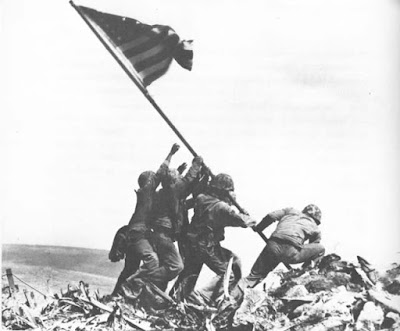
El tema cuenta la historia de Ira Hayes, un indio Pima de Arizona, que fue uno de los 6 Marines de la famosa fotografía de Joe Rosenthal, en la que se alzaba la bandera norteamericana en la cima del Monte Suribachi durante la Batalla de Iwo Jima. Como se muestra en la película de Clint Eastwood, "Banderas de Nuestros Padres" - en donde Adam Beach interpreta a Hayes -, el Presidente Roosevelt ordenó que los supervivientes de Iwo Jima que habían aparecido en la fotografía regresaran al país con la finalidad de patrocinar una colecta de bonos de guerra, y así, el marine indio volvió a su país como un héroe nacional y durante un tiempo disfrutó de la fama y del lujo. Sin embargo, fue relegado al olvido después de la guerra, y su vida estuvo marcada por el abuso del alcohol y los problemas con la justicia (fue arrestado 15 veces), muriendo los 32 años en la reserva donde nació, borracho, sólo, pobre y olvidado. Parece ser que la culpa de haber sobrevivido a la guerra le persiguió durante el resto de su vida. "Muchos hombres mejores que yo murieron. No podía dejar de pensar en ellos", decía.


Como es habitual, a continuación os dejo la letra de la canción, y un poco más abajo, un vídeo:
"Ira Hayes, 
Ira Hayes

Call him drunken Ira Hayes
He won't answer anymore
Not the whiskey drinkin' Indian 
Nor the Marine that went to war 

Gather round me people there's a story I would tell 
About a brave young Indian you should remember well 
From the land of the Pima Indian 
A proud and noble band 
Who farmed the Phoenix valley in Arizona land 

Down the ditches for a thousand years
The water grew Ira's peoples' crops
'Till the white man stole the water rights 
And the sparklin' water stopped 

Now Ira's folks were hungry 
And their land grew crops of weeds 
When war came, Ira volunteered 
And forgot the white man's greed 


Call him drunken Ira Hayes 
He won't answer anymore 
Not the whiskey drinkin' Indian 
Nor the Marine that went to war 

There they battled up Iwo Jima's hill, 
Two hundred and fifty men 
But only twenty-seven lived to walk back down again 

And when the fight was over 
And when Old Glory raised 
Among the men who held it high 
Was the Indian, Ira Hayes 

Call him drunken Ira Hayes
He won't answer anymore
Not the whiskey drinkin' Indian
Nor the Marine that went to war 

Ira returned a hero 
Celebrated through the land 
He was wined and speeched and honored; Everybody shook his hand 

But he was just a Pima Indian
No water, no crops, no chance 
At home nobody cared what Ira'd done 
And when did the Indians dance 

Call him drunken Ira Hayes 
He won't answer anymore 
Not the whiskey drinkin' Indian 
Nor the Marine that went to war 

Then Ira started drinkin' hard; 
Jail was often his home 
They'd let him raise the flag and lower it 
like you'd throw a dog a bone! 

He died drunk one mornin' 
Alone in the land he fought to save 
Two inches of water in a lonely ditch 
Was a grave for Ira Hayes 

Call him drunken Ira Hayes 
He won't answer anymore 
Not the whiskey drinkin' Indian 
 Nor the Marine that went to war 

Yeah, call him drunken Ira Hayes
But his land is just as dry 
And his ghost is lyin' thirsty 
In the ditch where Ira died"

domingo, 11 de diciembre de 2011

Canciones sobre la 2ª Guerra Mundial (2)

Continuamos con esta todavía imberbe sección, y lo hacemos transitando nuevamente terrenos metaleros. Si la primera entrega la protagonizaba Iron Maiden, hoy tenemos por aquí a una de las cuatro grandes bandas ("The Big Four") del thrash metal: Slayer.

¿El tema en cuestión? Pues, una de sus canciones más famosas y la vez controvertidas, "Angel of Death", escrita y compuesta por el guitarrista de la banda, Jeff Hanneman. Incluida en su álbum "Reign in Blood" (1986) habla del tristemente famoso médico nazi Josef Mengele - conocido como "el Ángel de la Muerte" - y de los terribles experimentos que realizó con humanos en el campo de concentración de Auschwitz.


"Angel of Death" causó indignación entre los sobrevivientes del holocausto, al igual que sus familias y público en general. La controversia generó que la banda fuese tildada de nazi y racista, acusaciones que han perseguido a Slayer a lo largo de su carrera, y que el grupo siempre ha negado. Según el otro guitarrista Kerry King: "Sí, los miembros de Slayer somos nazis, fascistas, comunistas—toda esa mierda. Y por supuesto recibimos las mayores críticas en Alemania. Siempre he dicho, 'lean la letra de la canción y díganme donde está lo ofensivo en ella. ¿No pueden ver que es un documental, o creen que Slayer está predicando sobre la Segunda Guerra Mundial?".

A continuación os dejo la letra de la canción, y un poco más abajo, un vídeo con subtítulos en castellano:

"Auschwitz, the meaning of pain
The why that I want you to die
Slow death, immense decay
Showers that cleanse you of your life
Forced in
Like cattle
You run
Stripped of
Your life´s worth
Human mice, for the Angel of Death
Four hundred thousand more to die
Angel of Death
Monarch to the kingdom of the dead
Sadistic, surgeon of demise
Sadist of the noblest blood
Destroying, without mercy
To benefit the Aryan race
Surgery, with no anesthesia
Fell the knife pierce you intensely
Inferior, no use to mankind
Strapped down screaming out to die
Angel of Death
Monarch to the kingdom of the dead
Infamous butcher,
Angel of Death
Pumped with fluid, inside your brain
Pressure in your skull begins pushing through your eyes
Burning flesh, drips away
Test of heat burns your skin, your mind starts to boil
Frigid cold, cracks your limbs
How long can you last
In this frozen water burial?
Sewn together, joining heads
Just a matter of time
´Til you rip yourselves apart
Millions laid out in their
Crowded tombs
Sickening ways to achieve
The holocaust
Seas of blood, bury life
Smell your death as it burns
Deep inside of you
Abacinate, eyes that bleed
Praying for the end of
Your wide awake nightmare
Wings of pain, reach out for you
His face of death staring down,
Your blood running cold
Injecting cells, dying eyes
Feeding on the screams of
The mutants he´s creating
Pathetic harmless victims
Left to die
Rancid Angel of Death
Flying free
Angel of Death
Monarch to the kingdom of the dead
Infamous butcher,
Angel of Death
Angel of Death"

jueves, 24 de noviembre de 2011

Canciones sobre la 2ª Guerra Mundial (1)

Inauguro una nueva sección del blog en la que iré haciendo un repaso a canciones cuyo contenido haga referencia a personajes o hechos acaecidos durante la contienda. No me refiero a canciones que se hicieron populares en la guerra o que fueran cantadas por los soldados, como "Lili Marleen"o "Katiusha" (eso quizás tendrá su propio sitio en el blog con un post o a través de su propia sección), sino a temas musicales posteriores al conflicto que de una manera u otra hablen de la WW II.

Protagoniza esta primera entrega, creo una de las canciones más conocidas sobre el tema: "Aces High", el mítico himno de la banda británica de heavy metal Iron Maiden, incluido en su album "Powerslave" (1984).

Escrita por el bajista y alma mater del grupo, Steve Harris, la canción cuenta la historia de un piloto de un Spitfire de la Royal Air Force (RAF) luchando contra los aviones de la Luftwaffe alemana (bombarderos y cazas Messerschmitt Bf-109) durante la Batalla de Inglaterra (1940). Es la segunda pista del disco, y va precedida de un extracto del discurso que Winston Churchill dio el 4 de junio de 1940, dos días después de la derrota de Francia.

Aquí os dejo la letra:

"There goes the siren that warns of the air raid,
Then comes the sound of the guns sending flak.
Out for the scramble we've got to get airborne,
Got to get up for the coming attack.

Jump in the cockpit and start up the engines,
Remove all the wheelblocks there's no time to waste.
Gathering speed as we head down the runway,
Got to get airborne before it's too late.

Running, scrambling, fire,
Rolling, turning, diving, going in again.
Running, scrambling, fire, Rolling, turning, diving,
Run, live to fly, fly to live, do or die.
Won't you run, live to fly, fly to live, Aces high!

Move in to fire at the mainstream of bombers,
Let off a sharp burst and then turn away.
Roll over, spin round to come in behind them,
Move to their blindsides and firing again.

Bandits at 8 O'clock move in behind us,
Ten ME-109's out of the sun.
Ascending and turning our Spitfires to face them,
Heading straight for them I press down my guns.

Rolling, turning, diving,
Rolling, turning, diving, going in again.
Rolling, turning, diving, Rolling, turning, diving,
Run, live to fly, fly to live, do or die.
Won't you run, live to fly, fly to live, Aces high!!!"

Y aquí os dejo el vídeo oficial de la canción, que incluye imágenes reales de la Batalla de Inglaterra: